

Imagine a child clutching their mother’s leg, tears streaming down their face, begging not to visit the father whose fists left bruises they can’t explain. Now picture a judge, unmoved, accusing the mother of “brainwashing” and signing over custody to the very man the child fears.
This isn’t a courtroom drama—it’s the grim reality of family courts where “parental alienation” has become a legal strategy, not a psychological truth. Marketed as science, but built on sand, this discredited theory hands abusers a roadmap to custody—while silencing and punishing the parents trying to protect their children.
The Shaky Myth Behind Parental Alienation
Parental alienation sounds clinical: one parent turns a child against the other. Peel back the layers, and it’s a flimsy theory built on sand. It began with Richard Gardner’s “Parental Alienation Syndrome” (PAS) in the 1980s—a psychiatrist’s brainstorm lacking peer-reviewed evidence. The American Psychological Association rejects it, the DSM-5 omits it, and the World Health Organization won’t touch it. Dr. Paul Fink, former president of the American Psychiatric Association,called it “junk science” in 2006. Yet, family courts cling to it. Why? It’s a goldmine for abusers. When a child recoils from visits, abusers cry “alienation,” and judges— untrained in psychology—swallow it whole. This isn’t science; it’s a script for custody battles.

Behind closed doors, sleazy lawyers smirk at their abusive clients: “Forget denying the abuse—just whisper ‘alienation’, and watch the court, citing ‘the best interest of the child,’ ignore the bruises and gift-wrap your kids to you—the very monster they fear and hide from in closets. It fools the judges every time.”
Abusers’ Playbook to Steal Custody
In family court, parental alienation is an abuser’s trump card.
Here’s how the playbook works:
A protective parent reports abuse—physical, sexual, or emotional.
The accused abuser responds: “She’s turning the child against me.”
Judges accept the alienation claim, despite lack of evidence.
Custody is transferred to the abuser.
Real alienation begins: the child is cut off from the protective parent, manipulated, and isolated.
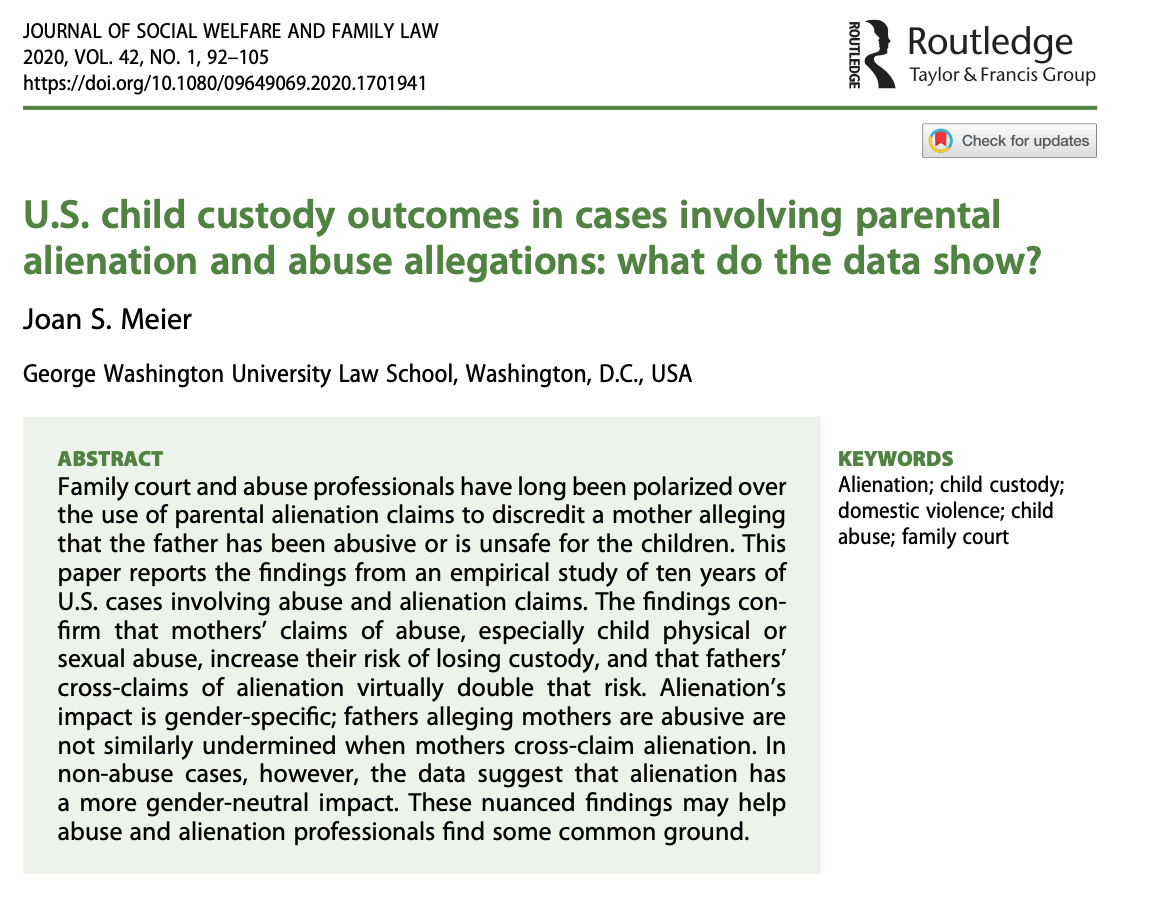
Joan Meier’s 2019 analysis of over 2,000 cases (GWU Law Review) found that when fathers claim alienation, mothers alleging abuse lose custody twice as often—and in cases involving sexual abuse, three times as often.
The Real Alienation Begins
Here’s the brutal twist: once abusers secure custody, they don’t heal—they harm and create psychological prisons. With the child now under their control, the manipulation deepens. They gaslight the child with phrases like, “Your mother never loved you,” or “She’s the reason your life is miserable.” They block phone calls, prevent visits, and erase every connection to the protective parent. This isn’t co-parenting—it’s erasure.
Here’s what the psychology reveals
Children placed with abusive parents often develop trauma bonds, a psychological survival mechanism. In these high-stress, emotionally volatile environments, kids align with the abuser—not out of loyalty, but out of fear. They learn to appease, comply, and emotionally adapt to their oppressor’s narrative in order to survive. This bond can appear like affection or obedience, but it’s a deeply rooted symptom of chronic abuse and helplessness.
This is reinforced by coercive control—a form of ongoing psychological manipulation where the abuser isolates the child, distorts their perception of reality, and instills fear of punishment or abandonment if they express loyalty to the protective parent.
Attachment trauma also plays a role. Children are biologically wired to seek closeness with caregivers, even harmful ones. When forced to live with an abusive parent, they repress negative emotions to maintain the relationship—internalizing guilt, self-blame, and shame. Over time, the child may echo the abuser’s language and beliefs—not because they've been "brainwashed" by the other parent, but because they’ve been systematically coerced and psychologically dismantled.
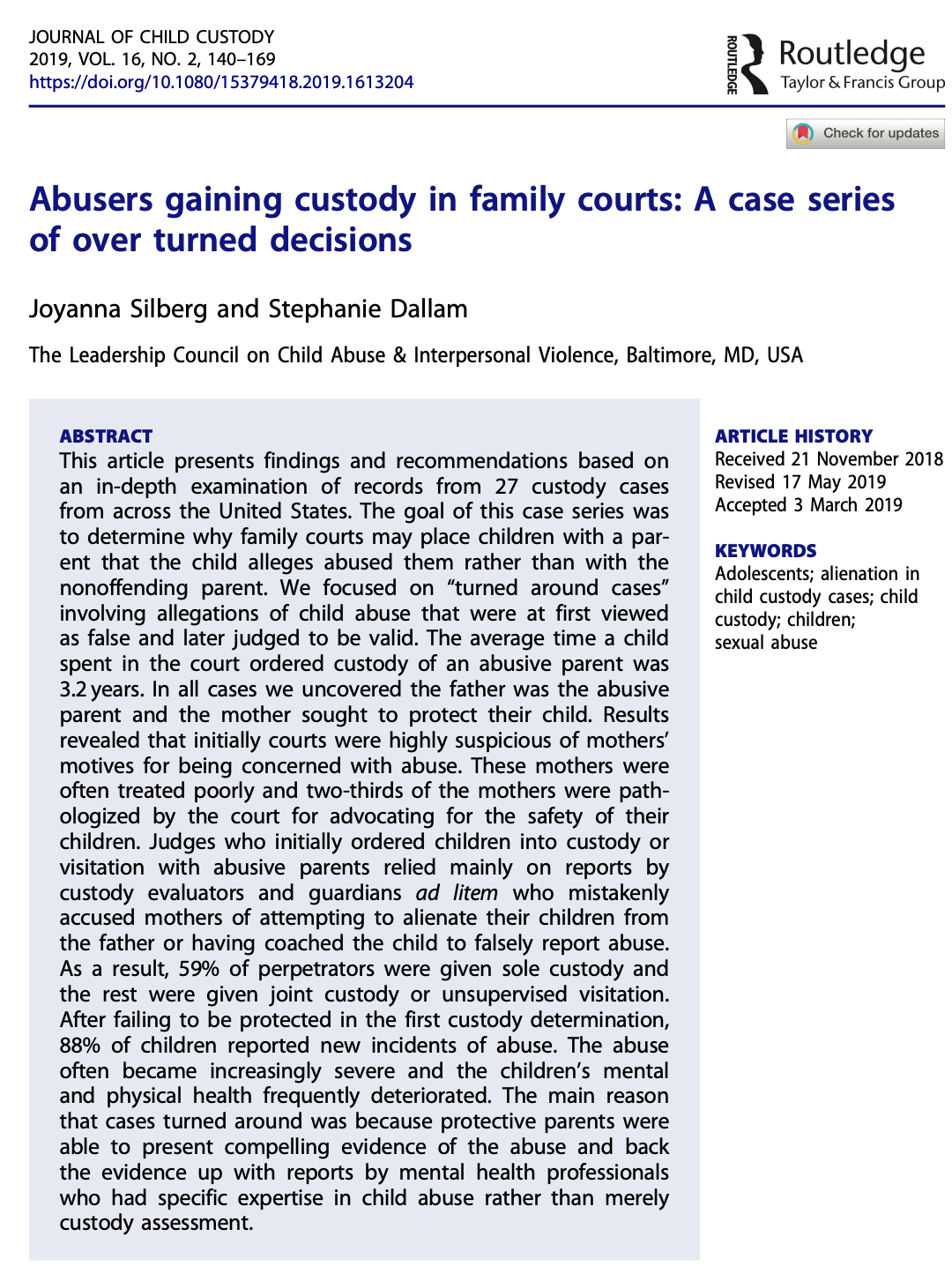
A 2019 study by Joyanna Silberg and Stephanie Dallam, published by The Leadership Council on Child Abuse & Interpersonal Violence, found that 59% of alleged abusers were awarded sole custody, while most of the rest received joint custody or unsupervised visitation. Of the children placed with these perpetrators, 88% reported new incidents of abuse after the custody transfer—confirming that the danger doesn’t end when the gavel falls.
This is not the “alienation” family courts claim to fight—it’s the one they actively create.
By ignoring abuse allegations and granting custody to abusers, courts lock children into a psychological cage, where survival means submission, and love is twisted into fear.
Why Courts Keep Buying the Lie
Family courts cling to “parental alienation” because it’s simpler than facing the messiness of real abuse.
Meanwhile, research on Adverse Childhood Experiences (ACEs) shows that forced contact with abusive parents leads to depression, anxiety, substance abuse, increased risk for violence, smoking, heart disease, obesity, suicide attempts, absenteeism, sexually transmitted diseases, even early death (Felitti et al., 1998; Crandell et al., 2019; Horan & Spatz Widom, 2015; Burke et al.; 2024).
Parental Alienation Is Not a Diagnosis — It’s a Legal Strategy
Let’s be clear: Parental alienation is not a clinical condition. It is a legal strategy, often used by abusive parents to:
Avoid accountability for violence or neglect.
Punish protective parents for trying to shield their children.
Regain control of the children and continue abuse.
The Business of Alienation: Who Profits?
Parental alienation is not just a flawed idea—it’s a lucrative industry. Once a protective parent is labeled the “alienator,” courts often mandate costly “reunification therapy” and appoint so-called alienation experts. These programs and evaluators charge thousands of dollars to “repair” a relationship the child was never safe in to begin with.
Protective parents are forced to pay for services they oppose.
Children are compelled to attend unproven programs.
Abusers exploit court orders to further isolate their victims.
Read more about it here.
What Needs to Change: Reforming Family Court
Courts must stop treating parental alienation as a proven fact—it’s not.
Judges need specialized training in domestic violence, child trauma, and coercive control.
Family court professionals must learn to distinguish genuine abuse from false alienation claims used in retaliation.
Children’s voices must be heard—especially when they express fear or distress about a parent.
Recognize that a child’s resistance may be a response to trauma, not evidence of manipulation.
What you fail to realize is that there is in fact Parental Alienation occurring within these families. The abuser projects their toxic behavior onto the safe parent which is among other toxic behaviors, Parental Alienation. Parental Alienation is NOT junk science, it’s real. This is a matter of the mentally ill and abusive parent indoctrinating the child to hate the other parent while projecting their alienating behavior onto the safe parent.
Very well written piece as always. You are still fighting for your son and others even after he's gone. I wish you didn't have to be in this situation. Keep up the good fight, Mama Bear.