
Journalists Are the Only Heroes Fighting Judicial Corruption
The system won't police itself. It never has. Every major judicial scandal was exposed by reporters who refused to look away.

Every major judicial scandal in modern American history shares a quiet truth.
It was not uncovered by a judicial conduct board.
It was not stopped by internal oversight.
It was not exposed by sealed complaints quietly dismissed behind closed doors.
It was uncovered by journalists.

This is not an opinion.
It is an observable pattern.
When accountability finally arrives in powerful courts, it rarely comes because institutions worked as designed. It comes because reporters did what institutions could not—or would not—do: follow evidence, connect patterns, and refuse silence.
Family court is the next investigation waiting to happen.
Parents See the Misconduct First. They Just Can’t Prove It Alone.
People who pass through family court almost always notice that something is wrong.
They see judges behave in ways that feel retaliatory or dismissive of evidence. They watch guardians ad litems (GALs) and custody evaluators produce reports that contradict the record, minimize abuse, or pathologize one parent while excusing another. They notice patterns—repeat experts, repeat outcomes, repeat punishments for parents who object.
So they do what they are told to do.
They file complaints with judicial conduct boards.
They report evaluators to licensing authorities.
They submit transcripts, affidavits, timelines, documentation.
And then—nothing happens.
This silence is not proof that nothing is wrong. It is proof that the system is built to absorb complaints without consequence.
A Cautionary Precedent: Kids for Cash
Kids for Cash refers to a judicial corruption scheme in Luzerne County, Pennsylvania, in which judges Mark Ciavarella and Michael Conahan later admitted to accepting illegal payments connected to private juvenile detention facilities and sentencing thousands of children—often for minor offenses—to those facilities.
Long before the Kids for Cash scandal became nationally known, complaints already existed.
Parents complained.
Defense attorneys raised alarms.
Concerns about judicial behavior were formally submitted to oversight bodies.
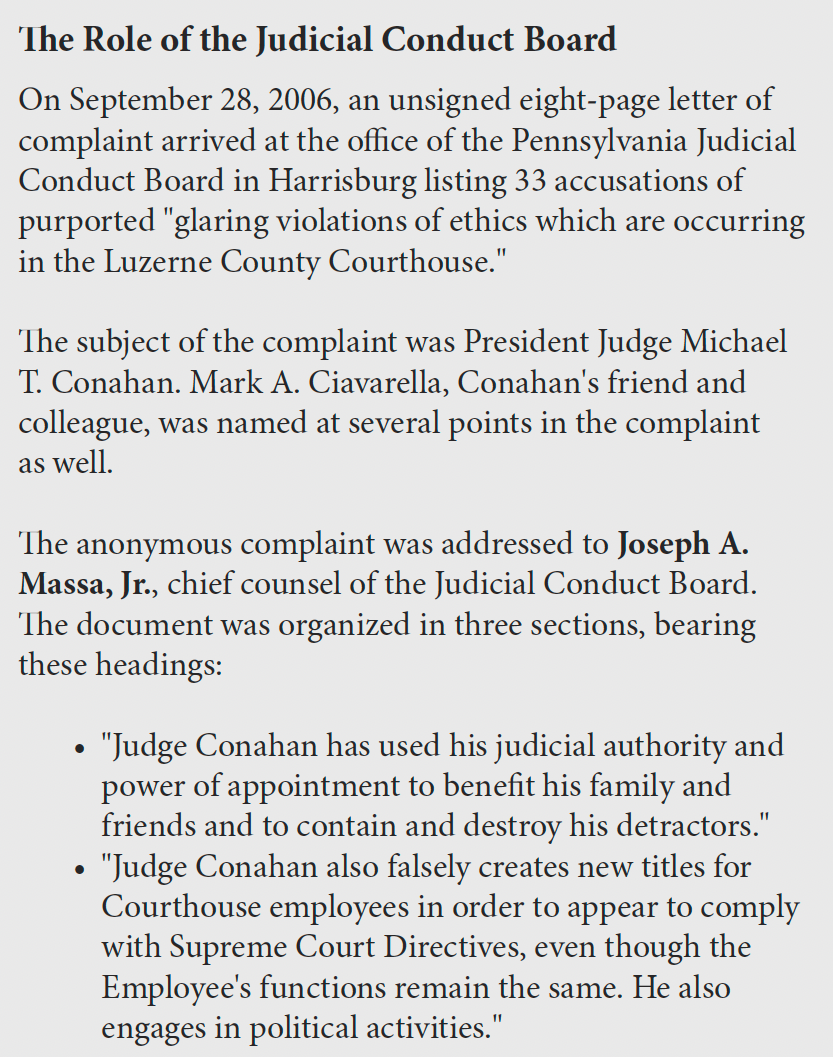
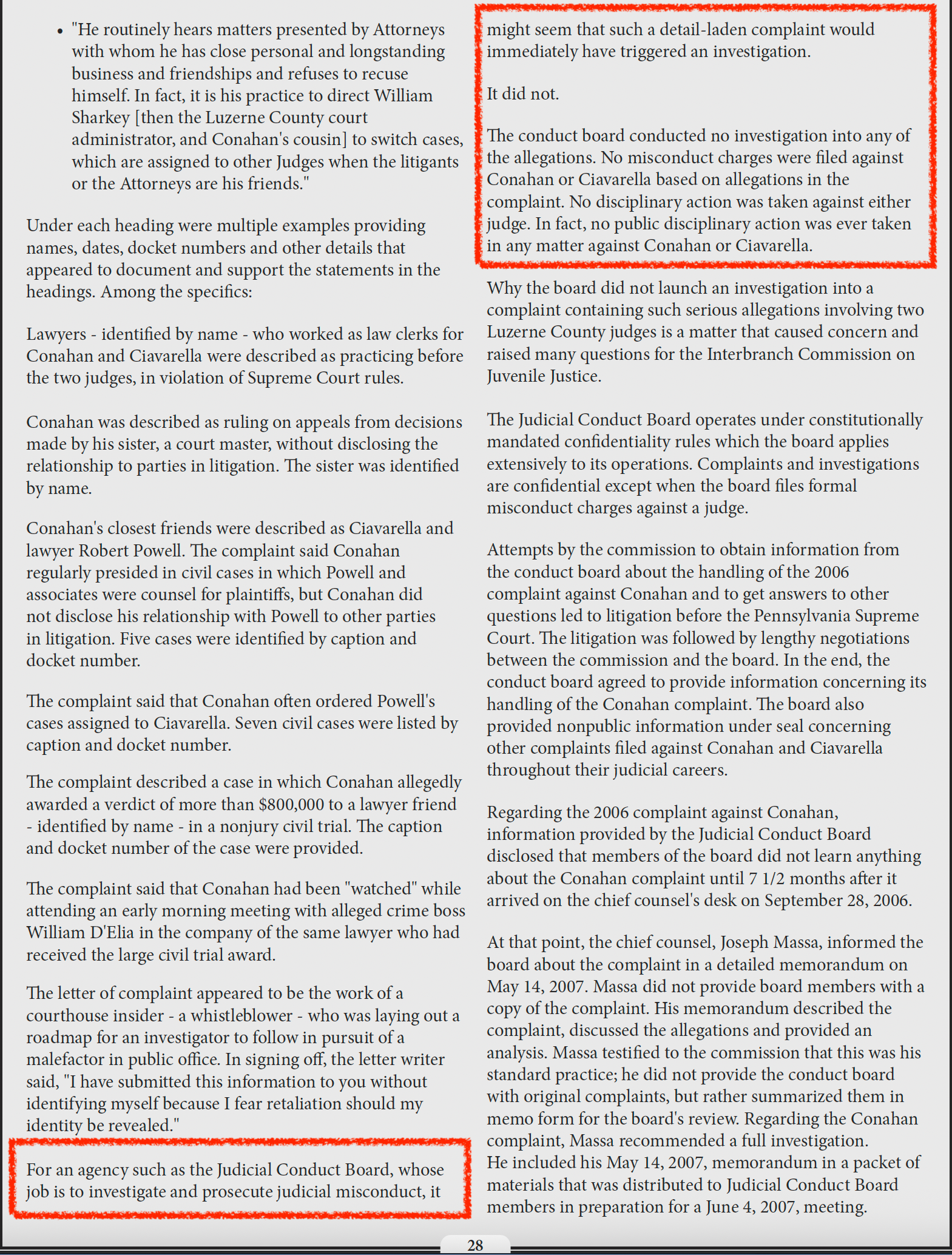
As early as the mid-2000s, complaints about Judge Michael Conahan were filed with the Pennsylvania Judicial Conduct Board. Those complaints were dismissed. No corrective action followed. The judges remained on the bench.
The Interbranch Commission on Juvenile Justice later documented this failure in detail. Relevant excerpts from the Commission’s report are shown below:
Source: https://www.pacourts.us/Storage/media/pdfs/20210211/014130-finalreport-000730.pdf
For years afterward, children continued to be sent to detention for minor offenses.
The system had the information.
It simply did not act on it.
Only later—after patterns became impossible to ignore and federal investigators intervened—did accountability arrive. Thousands of juvenile convictions were vacated. Judges were prosecuted and imprisoned.
The critical lesson is not that complaints were absent.
It is that complaints were present—and structurally ignored.
The Numbers Tell the Same Story
This dynamic is not unique to one state or one scandal.
Between 2013 and 2023, thousands of judicial misconduct complaints were filed across the United States.
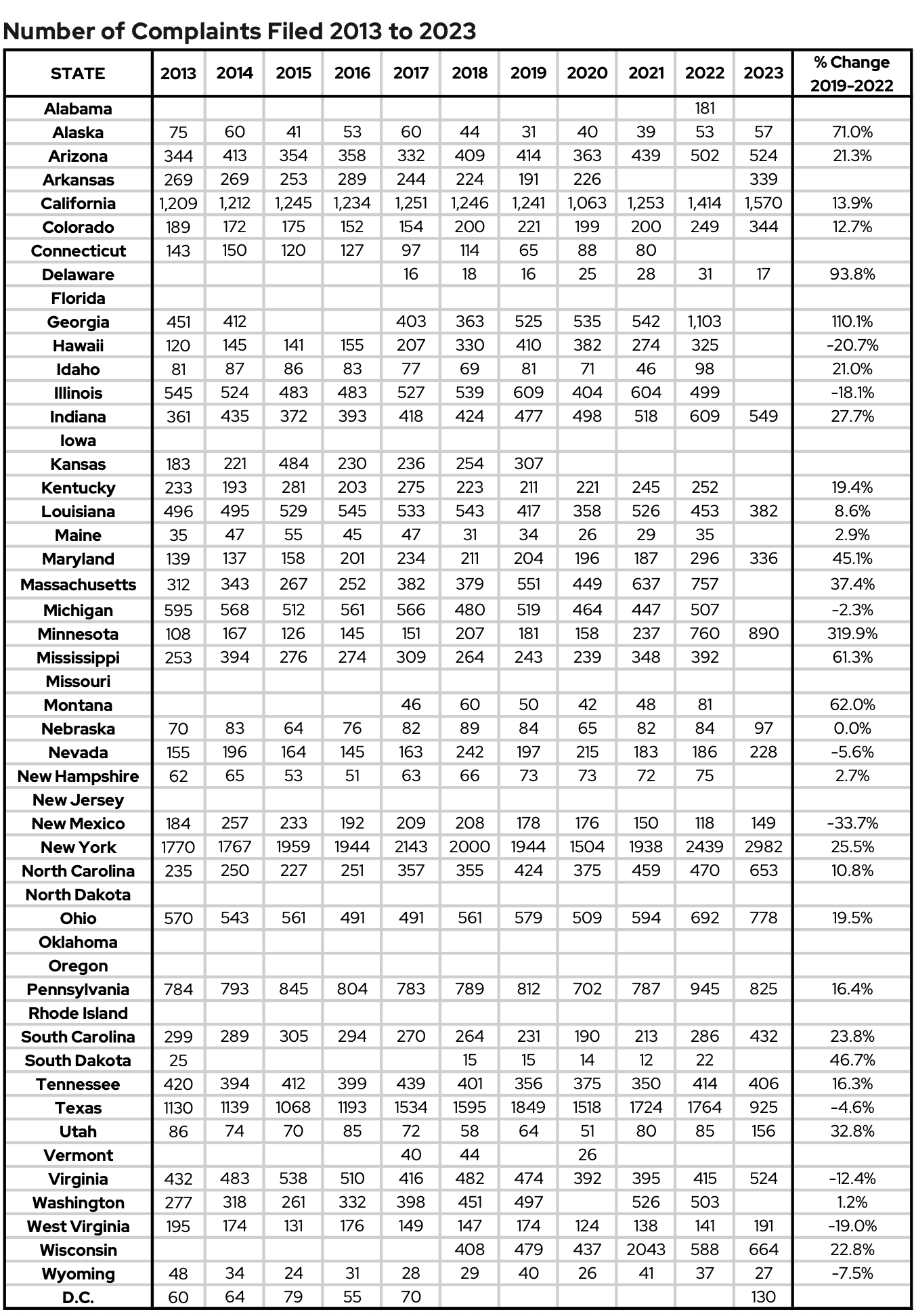
Source: https://statedemocracy.law.wisc.edu/wp-content/uploads/sites/1683/2024/07/State-Judicial-Conduct-Commission-White-Paper.pdf
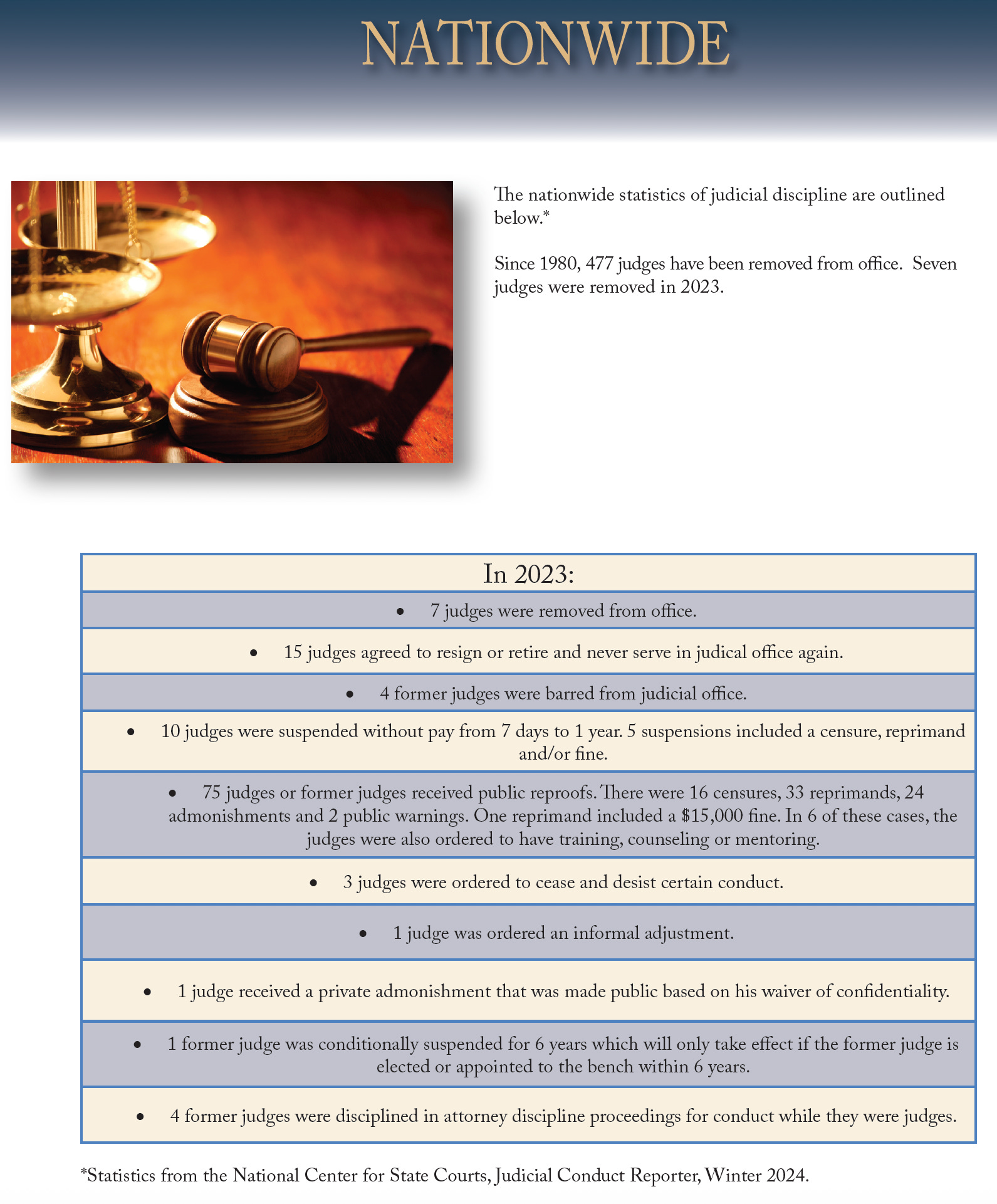
Yet the percentage of judges who face any meaningful discipline remains vanishingly small.
Even in 2023 and 2024, official reports show that while hundreds of complaints were received nationwide, only a tiny fraction resulted in discipline, and an even smaller number led to serious consequences.
Source: https://judicialconductboardofpa.org/wp-content/uploads/2023-Annual-Report-Judicial-Conduct-Board-of-Pennsylvania.pdf
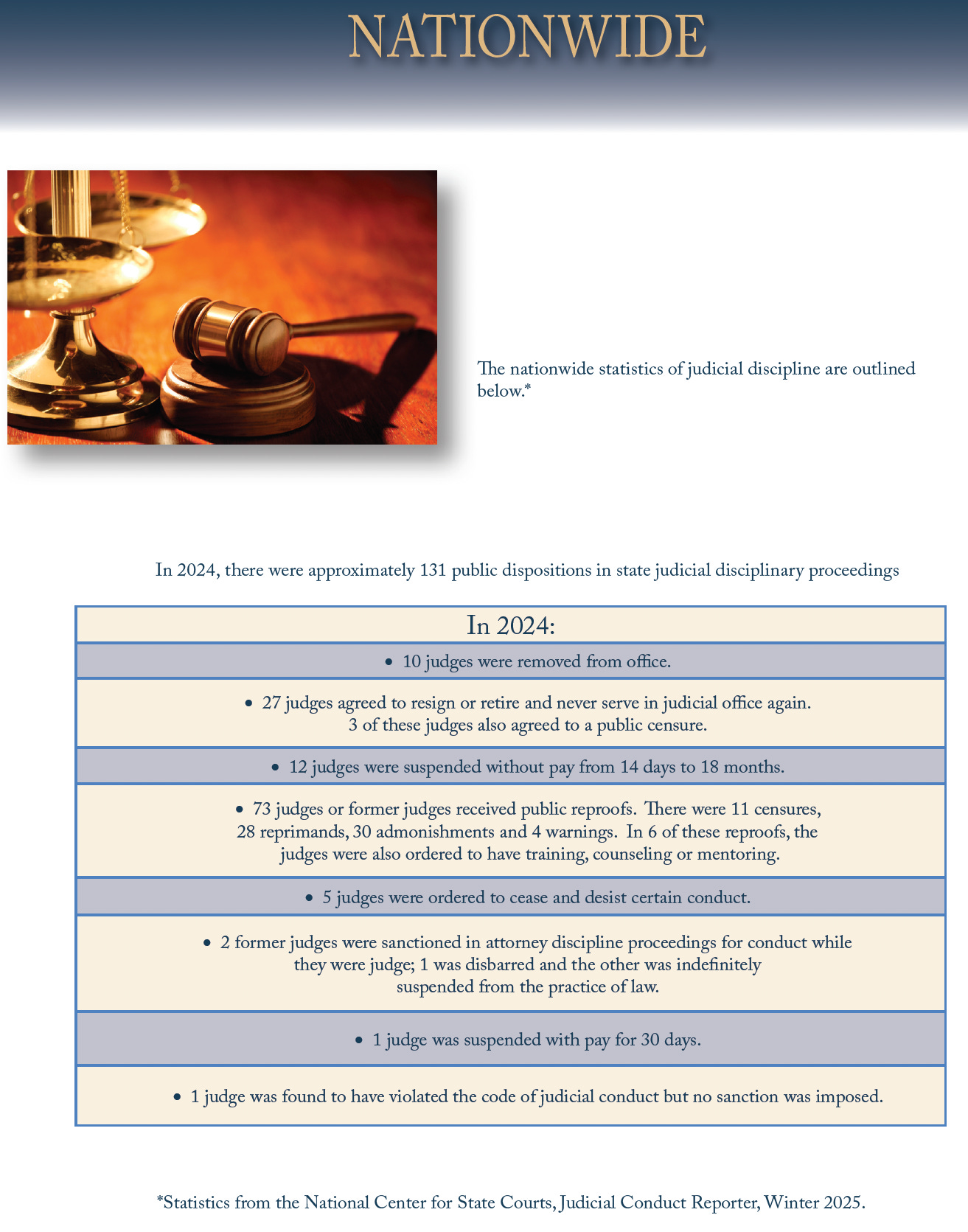
Source: https://judicialconductboardofpa.org/wp-content/uploads/2024-Annual-Report-Judicial-Conduct-Board-of-Pennsylvania.pdf
Judicial immunity shields conduct from review. Oversight bodies are narrow, opaque, and slow by design. Professional boards defer to courts; courts defer to professional boards. Responsibility circulates endlessly. Accountability never lands.
Parents learn quickly that the closer you are to the harm, the less power you have to expose it.
Why Journalists Break the Story
When we look at how judicial misconduct is actually uncovered, the mechanism is strikingly consistent.
It is not litigants.
It is not internal discipline.
It is investigative journalism.
A recent example makes this impossible to ignore.
Judge Leslie Ann Celebrezze: What Oversight Missed, Journalism Found

For years, concerns circulated quietly around Judge Leslie Ann Celebrezze, a powerful domestic relations judge in Cuyahoga County, Ohio.
Complaints existed.
Concerns accumulated.
Nothing changed.
What finally altered the trajectory was not internal review. It was sustained investigative reporting.
Over the course of roughly two years, The Marshall Project (Cleveland) examined Judge Celebrezze’s courtroom practices as a system rather than as isolated incidents. Reporters did what litigants could not:
compared cases across time
analyzed assignment patterns
examined financial relationships
followed money through court-appointed roles
That reporting documented how Judge Celebrezze repeatedly steered cases and hundreds of thousands of dollars in court-ordered fees to a closely connected receiver, raising serious questions about conflicts of interest, self-assignment of cases, and abuse of discretion.
These were not secrets hidden in a single file. They were patterns—visible only when cases were aggregated.
As a result of that reporting:
ethics and criminal investigations intensified
grand jury subpoenas were issued
public scrutiny became unavoidable
On December 22, 2025, Judge Celebrezze resigned and was charged with a felony related to tampering with public records.
The system had years to act.
It did not.
Journalism did.
Why Oversight Failed—and Reporting Didn’t
Judicial conduct systems are designed to evaluate individual complaints in isolation. Journalism is designed to do the opposite.
Oversight asks: Did this judge violate a rule in this case?
Journalism asks: Why does this keep happening across cases, years, and families?
That difference matters.
Parents could describe what they were experiencing.
They could not access system-wide data.
They could not safely compare cases.
They could not publish without retaliation.
Journalists could.
And when they did, accountability followed.
Why Family Court Is a Journalist’s Beat—Whether It’s Claimed or Not
Family court is one of the most powerful legal systems in the country—and one of the least scrutinized.
Its decisions permanently reshape families.
Its proceedings are largely sealed.
Its actors—judges, evaluators, GALs—exercise extraordinary discretion with minimal transparency.
This is not accidental. Secrecy is protective.
Each family is treated as an isolated case. Patterns are obscured. Parents are labeled “high conflict” the moment they protest. Without public scrutiny, structural behavior remains invisible.
But invisibility is not innocence.
For journalists, family court presents something rare:
immense power
weak oversight
repeatable actors
accessible records (with effort)
sources who are already documenting everything
Parents already have fragments of the truth.
What they lack is the ability to assemble it safely.
Journalists can.
Parents Are Already Trying to Tell You
Parents do not contact journalists because they want attention. They do it because every internal avenue has failed.
They reach out quietly.
Often anonymously.
Often apologetically.
They do not ask for advocacy.
They ask for examination.
And when journalism declines to look at family court, the message they receive is devastating: that some systems are simply too inconvenient to investigate.
History suggests otherwise.
Every time journalists have chosen to look—really look—judicial power structures have yielded truths the system insisted did not exist.
This Is What Accountability Actually Looks Like
Judicial conduct boards exist on paper.
Licensing oversight exists on paper.
Ethics rules exist on paper.
But accountability in reality has always required public scrutiny.
Not outrage.
Not slogans.
Not viral clips.
Reporting.
The kind that follows money.
The kind that compares cases.
The kind that asks why the same experts keep appearing, why the same parents are punished for speaking, why complaints disappear without explanation.
Family court is not a niche issue.
It is a blind spot.
And blind spots are where journalism matters most.
Start Small. Go Big.
You don’t need a blockbuster scandal on day one.
Start with one judge.
One county.
One evaluator.
Pull appointment records.
Compare cases.
Follow the fees.
The families will find you.
The documents will tell the story.
Family court is a systemic accountability story affecting millions—happening quietly, repeatedly, and largely uncovered.
Someone will break this story wide open in every state.
Silence protects power. Journalism breaks it.